
Publications
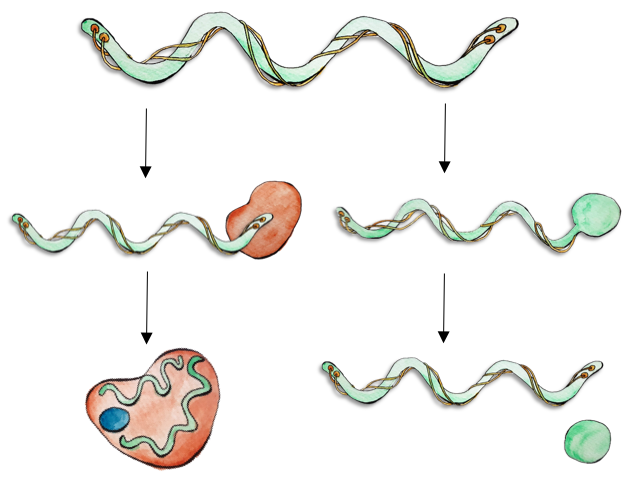
A new chemotaxis sensor in spirochetes.
Muok, A.R., Kurniyati, K., Ortega, D.R., Olsthoorn, F., Sidi Mabrouk, A., Li, C., Briegel, A. BioRxiv. 2022.
In this preprint, I examine the role of an uncharacterized protein, called CheWS, in the spirochete life cycle. CheWS is a variant of the chemotaxis protein CheW that possesses an additional fused domain, which senses the small molecule S-adenosylmethionine (SAM). This domain is responsible for chemotaxis towards SAM, but also alters round body and biofilm formation.
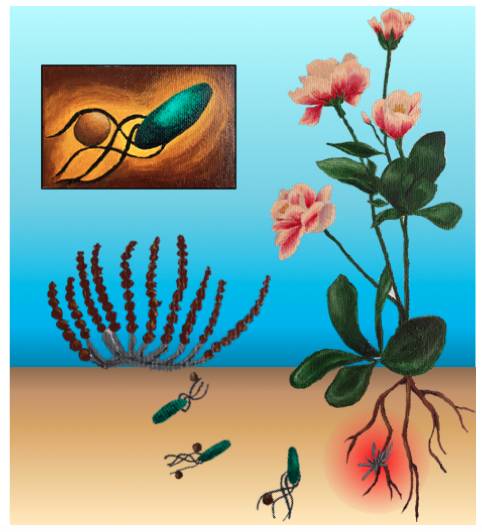
Microbial hitchhike
Muok, A.R., Briegel, A., and Claessen, D. ISMEJ. 2021.
In this manuscript I show that immotile Streptomyces spores are able to hitchhike motile bacteria natively found in their vicinity for migration to plant tissues. Using motility assays, I show that Bacillus subtilis can move the spores to plant tissues and that this movement is dependent on the presence of flagella. Through various electron microscopy methods, I show that the flagella interact with the rodlet layer found on the spore coat. I used genetic mutants to confirm the importance of the rodlet layer for this interaction.
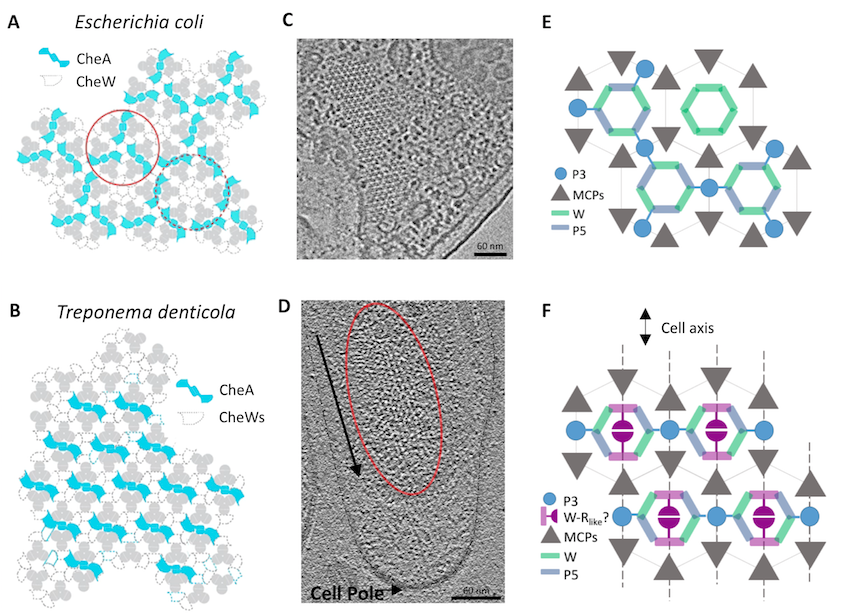
A new chemotaxis array symmetry
Muok et al. Nat Comms. 2020.
While the bacterial chemotaxis system has been studied for several decades in very diverse bacteria, all bacteria were found to possess a pseudo-P6 symmetry in the array. Here, for the first time, I show an alternative (P2) symmetry of the arrays, which are in pathogenic Spirochetes. This manuscript showcases how cryo-ET coupled with crystallography and biochemistry can synergistically answer questions across biological scales.
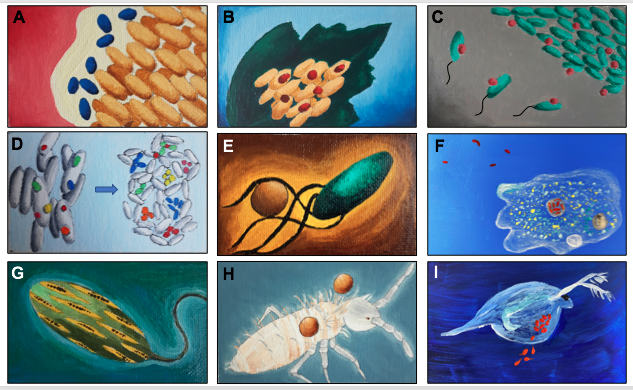
A Hitchhiker’s Guide
Muok, A.R. and Briegel, A. Trends Microbiol. 2020
In this first-ever review of intermicrobial hitchhiking, I examine reports of hitchhiking in both prokaryotes and eukaryotes. After drawing out the similarities and differences among them, I make important connections to their potential impacts on plant and human health. Best of all, Ariane Briegel and I hand-painted the key figure for this review.
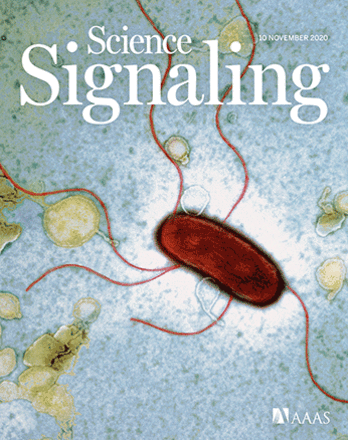
Trapping CheA transitions
Muok et al. Sci. Signal. 2020.
The kinase CheA is essential for chemotatic function. For some pathogenic microbes, deletion of CheA inhibits host infection. However, this protein is highly dynamic and various conformations have been associated with specific sensory states of the chemotaxis apparatus. Here, I apply structural and biochemical methods to elucidate a complete all-atom model for the kinase-inactive signalling state. To accomplish this, I first engineered a chimeric, soluble chemotaxis complex that enables further in vitro exploration into this system. This paper was also chosen for the cover story of this issue!
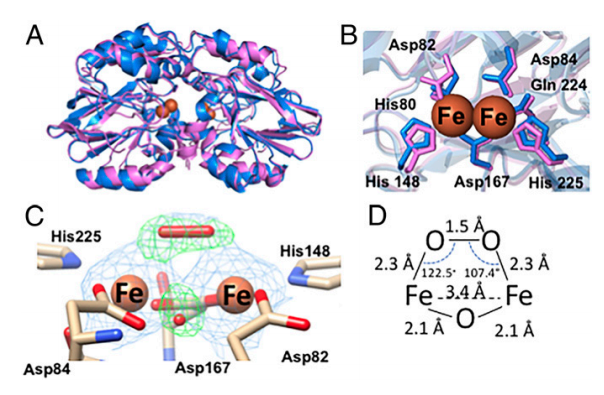
A new class of chemotaxis sensor
Muok et al. PNAS. 2019.
Typically, the chemotaxis system consists of three proteins that comprise the main structure of chemotaxis arrays. However, some organisms, such as pathogenic Spirochetes, possess uncharacterized chemotaxis proteins. Here, I use structural, biochemical, and spectroscopic methods to characterize one such protein, which I have named Oxygen Diiron Protien (ODP). I found that ODP is an oxygen sensor that modulates chemotaxis behavior via an iron-peroxy adduct.
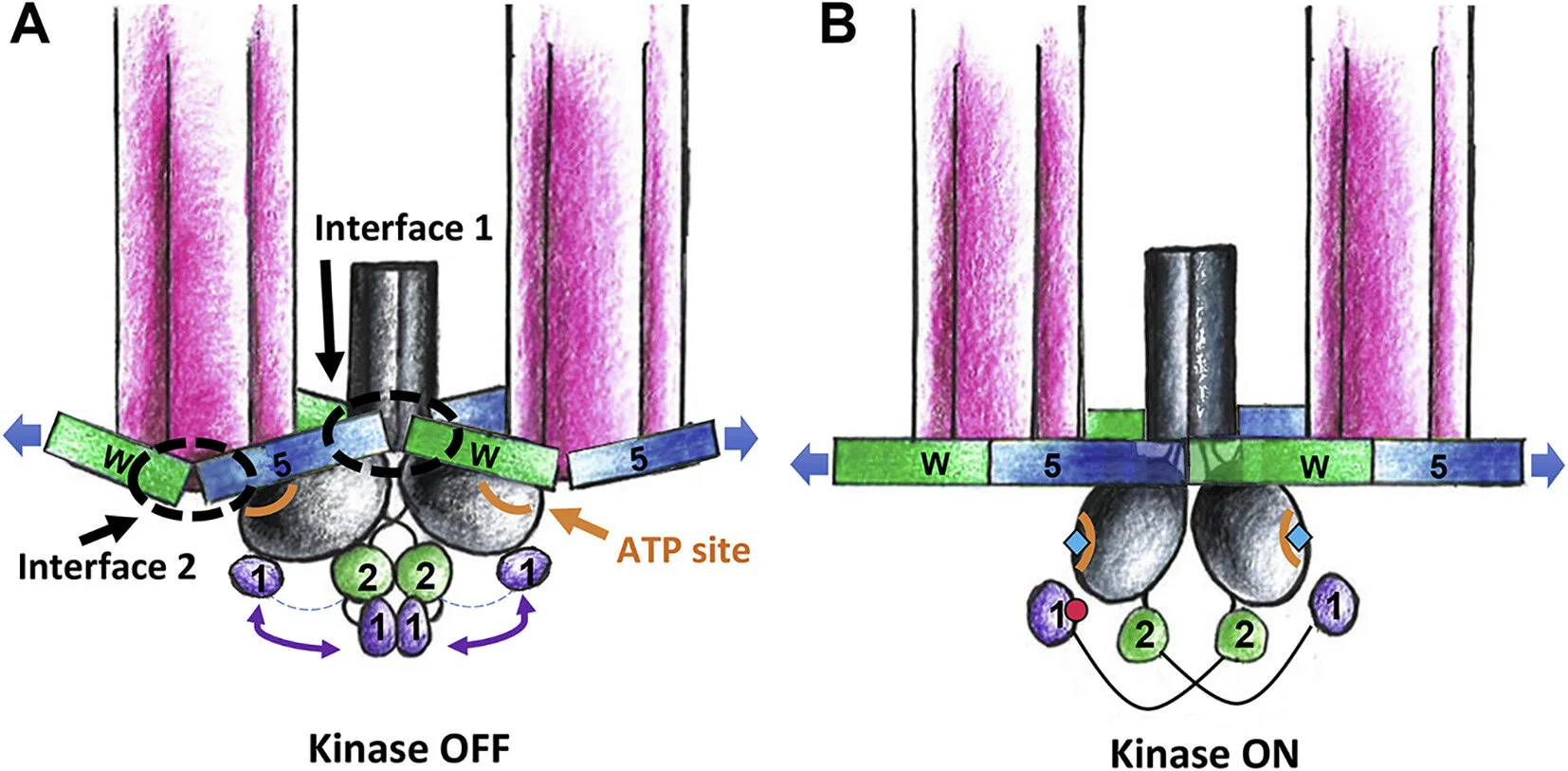
CheA: making sense of it all
Muok, A.R., Briegel, A., and Crane, B.C. BBA-Biomem. 2019.
The chemotaxis kinase CheA undergoes dramatic structural rearrangements between the kinase-on and kinase-off state. Here, I consolidate structural and enzymatic reports of CheA, and use this information to generate a model for CheA in both activity states.
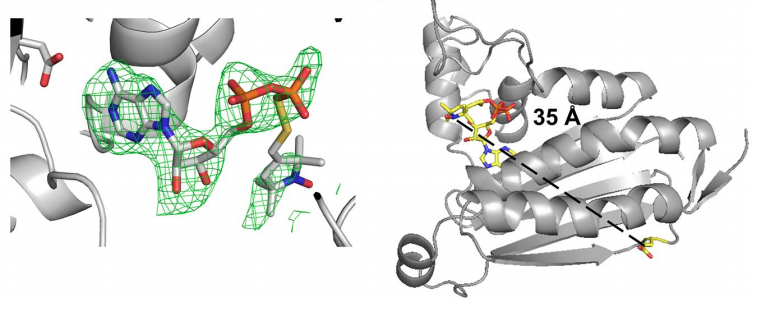
A new structural probe for ATP-binding proteins
Muok, A.R., T.K. Chua, Le, H., and B.R. Crane. Appl. Mag. Res. 2018.
A limitation of electron spin resonance spectroscopy is that you have to mutate and modify protein residues so that they possess a spin label. Therefore, labeling active sites or protein:protein interaction regions may be deleterious to the study; the protein may no longer be functional. Here, I synthesized a spin label on a non-hydrolyzable ADP analog that can be used to label ATP—binding pockets without protein modifications. I demonstrate the efficacy of the probe on my favorite protein—CheA!
Other manuscripts
G.E. Merz, P. Borbat, A.R. Muok, J.H. Freed, B.R. Crane. (2018) Site-specific incorporation of a Cu+2 ion for measuring distances using pulsed dipolar ESR spectroscopy. J. Physical Chemistry.
R. Kerwin, J. Feusier, A. Muok, C. Lin, B. Larson, D. Copeland, J. Corwin, M. Rubin, M. Francisco, B. Li, B. Joseph, D. Kliebenstein. (2017) Epistatic by environment interactions among Arabidopsis thaliana glucosinolate genes impact complex traits and fitness in the field. New Phytologist.
A.R. Greenswag, A.R. Muok, X. Li, B.R. Crane. (2015) Conformational transitions that enable histidine kinase autophosphorylation and receptor array integration. J Mol Bio.
R. Kerwin, J. Feusier, J. Corwin, M. Rubin, C. Lin, A. Muok, B. Larson, B. Li, B. Joseph, M. Francisco, D. Copeland, C. Weinig, D.J. Kliebenstein. (2015). Natural genetic variation in Arabidopsis thaliana. eLife sciences Ecology.